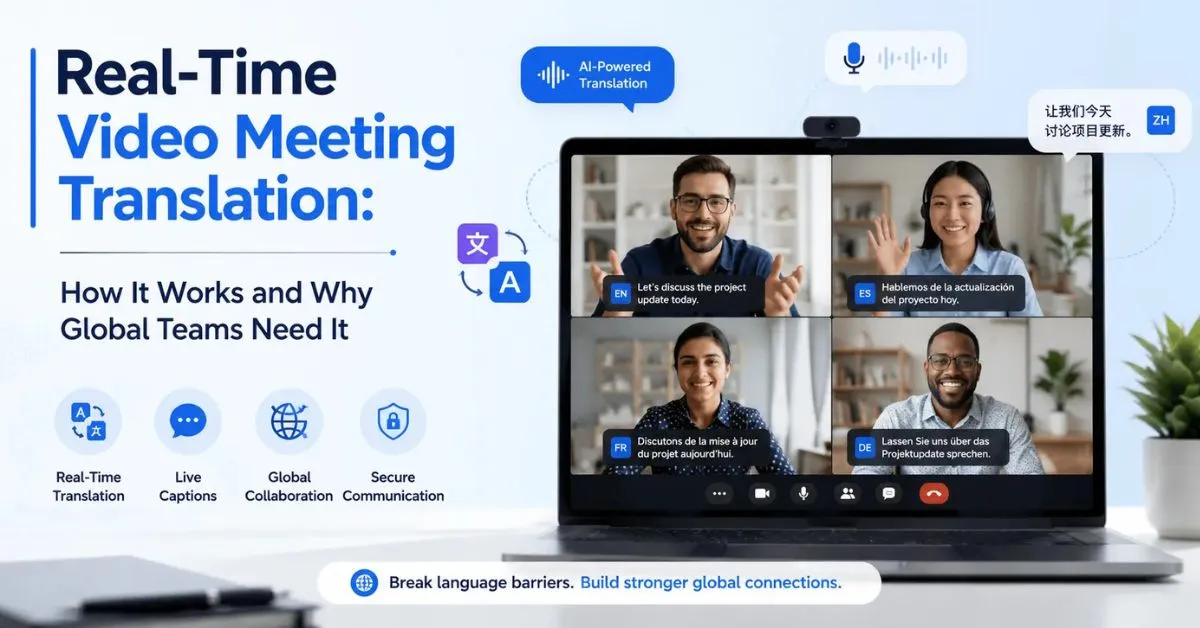
Modern work is no longer limited by office walls or geography. Today, businesses operate across countries, time zones, and cultures. A startup in Bengaluru may work with developers in Europe, clients in the Middle East, and marketing teams in Southeast Asia- all within the same project cycle. This is why Real-Time Video Meeting Translation is becoming essential for global teams to communicate smoothly without language barriers.
But while technology has made remote work easier, one challenge still slows global collaboration down: language barriers.
That is why real-time video meeting translation is becoming one of the most important innovations in business communication.
Instead of depending on translators or struggling through multilingual meetings, teams can now communicate naturally with AI-powered translation happening live during conversations.
For global businesses, this is changing the way meetings happen.
What Is Real-Time Video Meeting Translation?

Real-time video meeting translation is a technology that automatically translates spoken conversations during live online meetings.
As participants speak, AI systems:
- recognize the language
- convert speech into text
- translate the content instantly
- display subtitles or translated audio in real time
This allows people speaking different languages to collaborate smoothly during the same meeting without constant interruptions.
Modern multilingual video conferencing platforms are increasingly adding these capabilities to support international collaboration.
Why Language Barriers Still Affect Global Teams
Remote work has expanded rapidly, but communication challenges still exist inside international teams.
Even highly skilled employees may struggle when:
- meetings move too fast
- technical terminology becomes complex
- accents differ heavily
- discussions involve strategic decisions
Because of this, businesses often face:
- delayed communication
- misunderstood instructions
- lower meeting participation
- reduced collaboration efficiency
This is one reason companies are investing in better global team communication tools.
The goal is no longer just connecting teams.
It is helping them communicate clearly and confidently.
How Real-Time Video Meeting Translation Works
Behind every translated meeting, several AI systems work together simultaneously.
Here’s how the process usually works.
1. Speech Recognition
The platform first listens to spoken audio and converts it into text using AI speech recognition.
The system identifies:
- spoken language
- pronunciation
- voice patterns
- speaking speed
- regional accents
This step creates the foundation for accurate translation.
2. AI Language Processing
Once speech becomes text, advanced AI models analyze:
- sentence meaning
- context
- grammar
- conversational intent
This is where modern AI translation for meetings becomes significantly smarter than basic translation software.
Instead of translating word-by-word, the AI focuses on preserving meaning and context.
3. Instant Translation Delivery
The translated output is then displayed through:
- live subtitles
- translated captions
- real-time audio playback
- multilingual chat translation
This makes language translation in video calls and meetings feel more natural and less disruptive.
4. Continuous Learning Through AI
Most modern systems improve over time using machine learning.
As more conversations happen, the software becomes better at:
- understanding accents
- recognizing industry-specific phrases
- handling multilingual discussions
- improving translation speed
This is why newer real-time translation software performs much better than older automated translation systems
Also Read: Why Cross-Platform Development is Key for Modern Enterprises
Why Global Teams Need Real-Time Translation
As organizations become more distributed, communication quality directly impacts productivity.
Here’s why businesses are increasingly focusing on breaking language barriers in video calls and meetings.
1. Faster International Collaboration
Without translation support, teams often:
- repeat discussions
- simplify conversations
- rely on follow-up emails
- delay decisions
A live video translation platform reduces these communication gaps and helps teams collaborate more efficiently.
2. Better Employee Participation
Many employees hesitate to speak during multilingual meetings because they worry about language fluency.
Real-time translation creates a more inclusive environment by helping participants:
- understand conversations clearly
- contribute confidently
- engage more actively
This improves both collaboration and team morale.
3. Improved Client Communication
Global businesses regularly interact with clients from different countries.
Using real-time video call translation helps businesses:
- reduce misunderstandings
- improve professionalism
- create smoother customer experiences
For sales teams, consultants, and support teams, this can significantly improve communication quality.
4. Reduced Dependence on Human Translators
Traditional interpreters are useful but difficult to scale for everyday meetings.
AI-powered translation allows businesses to:
- conduct meetings faster
- reduce operational costs
- support multilingual collaboration daily
without depending entirely on external translators.
Real-World Applications of Multilingual Video Conferencing
The demand for multilingual video conferencing is growing across industries.
1. Healthcare
Doctors can communicate more effectively with patients from different language backgrounds during virtual consultations.
2. Education
Online learning platforms can support international classrooms more efficiently.
3. SaaS and IT Companies
Distributed product and engineering teams can collaborate without language slowing down development cycles.
4. Customer Support
Support teams can assist international users more naturally through translated conversations.
Government and Enterprise Communication
Cross-border meetings become more accessible and efficient with live translation support.
Key Features Businesses Should Look For
Not every platform offers high-quality translation capabilities.
When choosing a live video translation platform, businesses should evaluate the following features carefully.
- Low-Latency Translation
Translations should appear almost instantly without slowing down the conversation flow.
- High Translation Accuracy
Business meetings require context-aware translations, especially for technical or professional discussions.
- Multilingual Support
The platform should support multiple regional and international languages.
- Enterprise-Grade Security
Since meetings often contain sensitive information, security is critical.
Look for:
- encrypted communication
- access controls
- authentication systems
- secure infrastructure
- Workflow Integration
The platform should integrate smoothly with:
- collaboration tools
- calendars
- CRMs
- project management systems
- enterprise workflows
Also Read: Secure Video Conferencing Software: Buyer’s Guide for Businesses
The Role of AI in the Future of Meetings
AI is rapidly transforming business communication.
Modern AI translation for meetings is evolving beyond subtitles into:
- real-time multilingual audio
- AI-generated meeting summaries
- contextual transcription
- intelligent conversation insights
- voice recognition systems
In the coming years, language may become far less of a barrier in digital collaboration.
How Platforms Like Daakia Are Adapting
Modern communication platforms are moving beyond standard video meetings.
Platforms like Daakia are increasingly focusing on:
- multilingual communication
- AI-powered collaboration
- secure enterprise communication
- real-time translation capabilities
- geographically distributed teamwork
As businesses become more global, these capabilities are becoming increasingly valuable for modern collaboration.
Challenges Still Exist
Even though the technology has improved significantly, some challenges remain.
These include:
- strong regional accents
- technical jargon
- cultural nuances
- complex sentence structures
That’s why businesses should treat AI translation as a collaboration enhancer rather than a complete replacement for human understanding.
The Bigger Shift in Global Communication
The rise of remote work has fundamentally changed how businesses communicate.
Teams are now built globally instead of locally.
As a result, companies are searching for:
- smarter communication systems
- multilingual collaboration tools
- secure virtual meeting platforms
- AI-powered workflow solutions
This is why cross-border team communication is becoming a major focus area for modern organizations.
Conclusion
Real-time video meeting translation is quickly becoming an essential part of modern business communication.
As teams become more global, businesses need tools that help employees collaborate naturally across languages without slowing productivity.
From improving inclusivity to accelerating decision-making, the benefits of real-time translation software are becoming increasingly clear.
Businesses that invest early in smarter communication technologies will be better prepared for the future of remote and international collaboration.
Frequently Asked Questions
- What is real-time video meeting translation?
Real-time video meeting translation uses AI to translate spoken conversations instantly during virtual meetings through subtitles, captions, or translated audio.
- How does language translation in video calls work?
Language translation in video calls works through AI speech recognition, natural language processing, and machine learning that convert spoken words into translated text or audio in real time.
- What are the benefits of multilingual video conferencing?
Multilingual video conferencing improves collaboration, increases participation, reduces communication barriers, and helps global teams work together more effectively.
- Why do businesses need real-time translation software for meetings?
Businesses use real-time translation software to improve international communication, support global teams, reduce misunderstandings, and simplify cross-border collaboration.
- What should businesses look for in a live video translation platform?
Businesses should look for translation accuracy, low latency, multilingual support, secure communication infrastructure, scalability, and workflow integrations in a live video translation platform.
Interesting Reads:
White-Label Video Conferencing: What It Is, How It Works, and the Best Platforms in India
What Is ISO 27001 Certification, and Why Should You Choose an ISO-Certified Communication Platform?